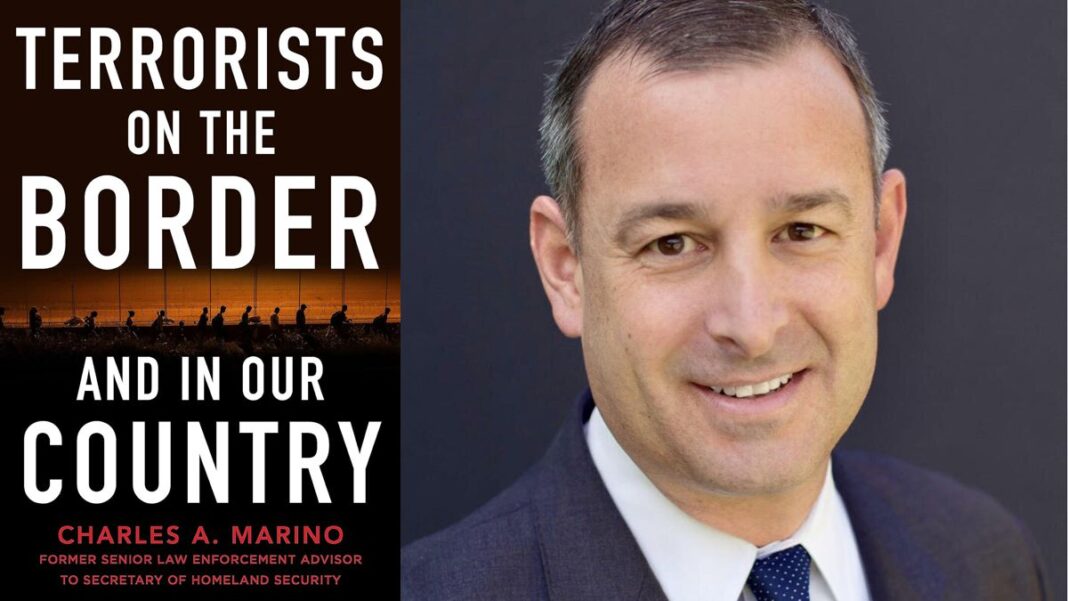


A nationally recognized security expert reveals the REAL Terrorist threat from the U.S. Southern Border and already INSIDE America. Terrorists on the Border and in Our Country reveals how radical, left-wing, liberal politicians and woke, progressive, “defund-the-police,” and “stop-the-wall,” nation-wrecking policies caused this crisis and the steps the country must take to combat crime, protect the homeland and its citizens and stop the growing existential challenge to Amercian freedoms and way of life.
Charles Marino outlines how and why Biden’s open border policies will ultimately destroy America from the Rio Grande up.
Some of the catastrophic problems created, enabled, or increased by weak borders include:
- Approximately 5 million migrants since the start of the Biden administration.
- Migrants from over 130 countries have been encountered.
- Over 100 migrants encountered on the terrorist watch list.
- Approaching 2 million “getaways” (unknown migrants who are not apprehended).
- Cartels are more empowered and funded than any time in history.
- Record breaking amounts of deadly fentanyl entering our cities.
- Increased violent crime, nationwide.
- Strain on infrastructure such as schools, hospitals, criminal justice systems, law enforcement, etc.
- Human trafficking/Sex trafficking.
- Erosion of American values and culture.
- Decriminalization of border and immigration laws.
Marino offers his expert recommendations—a step-by-step corrective and desperately needed policy roadmap—on how America can be saved. Before it’s too late.

About the Author
CHARLES A. MARINO (COLUMBIA, SOUTH CAROLINA) is a Nationally recognized security expert, strategic advisor, opinion leader, and writer with deep knowledge of security methodologies, tactics, and technology. A former Senior Law Enforcement Advisor to Secretary of Homeland Security and Supervisory Special Agent for the Secret Service and Chief Executive Officer of Sentinel Security Solutions, a leading Global Security and Crisis Management firm. The author lives and works in the Columbia metro area. Visit CharlesMarino.com
Excerpt. © Reprinted by permission. All rights reserved.
America-Mexico Border Policy Timeline from TERRORISTS ON THE BORDER AND IN OUR COUNTRY by Charles A. Marino
1819: The Adams-Onis Treaty between Spain and America defines the border between Spanish property (now Mexico) and America’s Louisiana Territory.
1821: Mexico wins independence from Spain, and the border between Mexico and the United States becomes the southern boundary of the newly formed Mexican Republic.
1830: Mexico bans immigration from the United States to rid its lands of English-speaking people.
1836: The Republic of Texas declares independence from Mexico, leading to the establishment of a disputed border between Texas and Mexico.
1845: The United States annexes Texas, further escalating tensions over the border.
1846-1848: The Mexican American War results in the Treaty of Guadalupe Hidalgo. The treaty establishes the Rio Grande as the boundary between Mexico and the United States, with the U.S. acquiring vast territories, including present-day California, Nevada, Utah, Arizona, New Mexico, and parts of Colorado and Wyoming.
1853: The Gadsden Purchase is made for $10 million, buying the United States additional land from Mexico for the construction of a southern transcontinental railroad. This purchase further solidifies the U.S./Mexico border.
1882: The Chinese Exclusion Act is passed, marking the first federal law that restricts immigration into the United States; border inspection stations are erected.
1904: Agents are assigned to patrol the border to better enforce the Chinese Exclusion Act
1910-1920: The Mexican Revolution takes place, leading to increased migration from Mexico to the United States, primarily driven by economic and political instability.
1924: The Immigration Act of 1924, (the Johnson-Reed Act) establishes a quota system for immigration, setting annual limits based on nationality and requiring fees for visas. It restricts immigration from Mexico; The U.S. Border Patrol is officially established.
1942: The Bracero Program is implemented, allowing temporary agricultural laborers from Mexico to work in the United States to address labor shortages during World War II and its aftermath.
1944: Title 42 (federal law) is crafted to prevent the spread of communicable diseases; it allowed the U.S. to deny migrants and/or asylum seekers entry if there is a national health crisis, pandemic, or other outbreak such as tuberculosis; Title 42 imparted no penalty on migrants for trying to cross the border illegally as Title 8 does today.
1947: U.S. and Mexico ratify the Inter-American Treaty of Reciprocal Assistance that says an attack on one nation is to be considered an attack upon the others. (America would later evoke the “Rio Act” after the terrorist attacks of 9/11.)
1954: Operation Wetback employs the U.S. Military to detain and deport illegal immigrants. The policy was quietly encouraged by the Mexican government who felt Mexico was losing too many laborers to the U.S.
1965: The Immigration and Nationality Act abolishes the national origins quota system and establishes a preference-based system focusing on family reunification and skilled labor. It results in increased immigration from Mexico and other parts of the world.
1969: The War on Drugs officially begins; U.S. installs agents on the border to inspect for illegal narcotics entering the U.S.
1973: U.S. DEA (Drug Enforcement Administration) is established
1980: Congress passes Title 8 of the US Code of Federal Regulations that establishes official immigration laws and defines “aliens.”
1986: The Immigration Reform and Control Act (IRCA) is enacted, granting amnesty to certain undocumented immigrants who entered the United States prior to 1982; It implements penalties for employers who knowingly hire undocumented workers.
1994: The North American Free Trade Agreement (NAFTA) is signed to promote an economic partnership between the United States, Mexico, and Canada.
2001: In the aftermath of the September 11 attacks, the U.S. government strengthens border security measures and creates the Department of Homeland Security (DHS) to bolster border and national security.
2006: The Secure Fence Act is signed into law, authorizing the construction of physical barriers along the U.S./Mexico border.
2008: The Merida Initiative anti-drug plan is launched; the U.S. provides Mexico with weapons, intelligence, training, technology, aircraft, and funds to combat importation of illegal drugs and the crime that comes with them.
2012: The Deferred Action for Childhood Arrivals (DACA) program is introduced by executive action; it’s designed to provide temporary relief from deportation for certain undocumented immigrants who arrived in the United States as minors.
2013: Merida 2.0 is launched.
2015: Nearly 700 miles of border fence is completed.
2016: Newly elected U.S. President Donald Trump promises to build a border wall.
2018: Due to an immigration surge largely spurred by the collapse of Central American economies, U.S. President Donald Trump launches the Migrant Protection Protocols (MPP) initiative, (also called “Remain in Mexico”) that forces asylum seekers who immigrate via Mexico to wait out their probationary period in Mexico rather than in the U.S.
2020: U.S., Mexico, and Canada sign USMCA, essentially NAFTA 2.0; Mexico passes a law that requires any Mexican official to get approval from a Mexican panel before meeting with U.S. agents. The law effectively cools drug enforcement relations between the two countries in that due to Mexican corruption, any such discussions/panel approval would likely compromise sensitive intelligence; Title 42 is evoked; it allows the U.S. to quickly turn migrants and asylum seekers away at the border due to Covid 19 fears.
2021: President Joe Biden takes office and signs several executive actions to reverse Trump-era immigration policies; The construction of the border wall is halted; Biden tries to end Trump’s “Remain in Mexico” policy, but he’s overruled by the courts in 2022; southern border is reopened after Covid fears dwindle.
2022: Migration at the border spikes to a then-all-time high in May of 2022, when the U.S. apprehends 239,416 illegal immigrants in one month as they try to cross the border.
2023: Title 42 is lifted under Biden; in three years it was used more that 2.8 million times to deny asylum seekers entry. Immigration code reverts to Title 8; asylum seekers are now processed on U.S. soil of which an estimated 99 percent are allowed entry.
June 2023: DHS Secretary Alejandro Mayorkas vows to reinstate the left’s “Sanctuary Country” directive that protects most illegal aliens from arrest and deportation if caught.
2024: ???