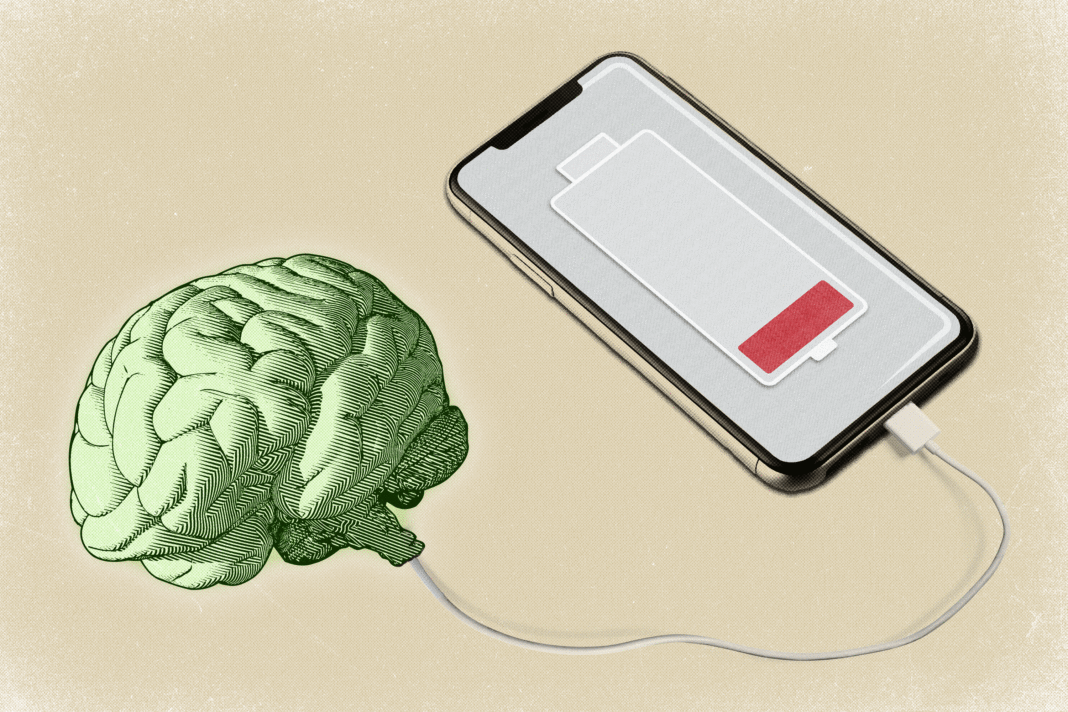


When Smartphones Get Smarter, Do We Get Dumber?

5Mind. The Meme Platform
The Epoch Times Header

As Mohamed  Elmasry, emeritus professor of computer engineering at the University of Waterloo, watched his 11 and 10-year-old grandchildren tapping away on their smartphones, he posed a simple question: “What’s one-third of nine?”

Instead of taking a moment to think, they immediately opened their calculator apps, he writes in his book “iMind Artificial and Real Intelligence.”

Later, fresh from a family vacation in Cuba, he asked them to name the island’s capital. Once again, their fingers flew to their devices, “Googling” the answer rather than recalling their recent experience.

With 60 percent of the global population—and 97 percent of those under 30—using smartphones, technology has inadvertently become an extension of our thinking process.

However, everything comes at a cost. Cognitive outsourcing, which involves relying on external systems to collect or process information, may increase one’s risk of cognitive decline.

Habitual GPS (global positioning system) use, for example, has been linked to a significant decrease in spatial memory, reducing one’s ability to navigate independently. As AI applications such as ChatGPT become a household norm—with 55 percent of Americans reporting regular AI use—recent studies found it is resulting in impaired critical thinking skills, dependency, loss of decision-making, and laziness.

Experts emphasize cultivating and prioritizing innate human skills that technology cannot replicate.

Neglected Real Intelligence

Referring to his grandkids and their overreliance on technology, Elmasry explains that they are far from “stupid.”

The problem is they are not using their real intelligence.

They, and the rest of their generation, have grown accustomed to using apps and digital devices—unconsciously defaulting to internet search engines such as Google rather than thinking it through.

Just as physical muscles atrophy without use, so too do our cognitive abilities weaken when we let technology think for us.

A telling case is now called the “Google effect,” or digital amnesia, as shown in a 2011 study from Columbia University.

Betsy Sparrow and colleagues at Columbia found that individuals tend to easily forget information that is readily available on the Internet.


Contact Your Elected Officials
The Epoch Times
The Epoch Timeshttps://www.theepochtimes.com/
Tired of biased news? The Epoch Times is truthful, factual news that other media outlets don't report. No spin. No agenda. Just honest journalism like it used to be.

Thoughts On America 250

Before you, American reader, is the honor, blessing, and privilege of celebrating the 250th anniversary of our nation. A nation toward which God has been merciful, shining His great grace.
00:09:03

Two birthdays apart

The Bicentennial was not just a commemoration of 200 years of independence – it was a coast‑to‑coast block party of red, white and blue.
00:02:31

Is Charlie Kirk’s Assassination Looking More Like a Conspiracy?

Enough videos have been posted to the internet, plenty...

Is There a 9/11 WTC and 9/10 Charlie Kirk Connection?

Strange parallels in online stories raise questions about whether Israelis and Mossad intelligence are our allies or adversaries.
00:27:01

Charlie Kirk Assassination Links Back to Israel

Google searches were conducted as early as July, on key elements in the September assassination of Charlie Kirk and the search information is being revealed.

Judge Blocks USPS Ballot Rule Tied to Trump’s Election Integrity Order

Judge blocked the U.S.P.S. from implementing a Trump admin. proposal to boost election integrity by enhancing ballot tracking and verification.

US Median Sales Price of Homes Hits Record High of $408,838

The median sales price of homes in the US hit a record high of $408,838 for the four weeks ending June 28, real estate brokerage Redfin said in a July 2 statement.
00:02:00

Rare Copy of Declaration of Independence Found in UK

Historians hail the significance of the finding, announced just...

Trump Administration Proposes Rule That Could Save Medicare Patients More Than $1 Billion

Trump administration officials are proposing a rule that would reduce Medicare spending on hospital services and drugs.

Trump Shares New US Passport Design on Truth Social

The mockup shows limited-edition passports planned for a July...
00:05:14

Trump Cancels Signing of Housing Affordability Bill, Says SAVE Act Should Be Passed First

Trump canceled signing of a bipartisan housing bill aimed at lowering home prices, saying an election integrity bill should be passed by Congress first.
00:39:13

Trump Signs Orders to Boost Development in Quantum Computing

President Trump signed two executive orders to accelerate quantum computing development and strengthen U.S. leadership in this emerging technology sector.

Banning Hospitals’ Certain Contracts Could Save Americans $45 Billion, Report Finds

A ban on certain contracts between hospital systems and health insurers could save Americans around $45 billion, according to a report.
spot_img

Related Articles

Popular Categories

MAGA Business Central