George Washington Carver was born into slavery in Diamond, Missouri, around 1864. The exact year and date of his birth are unknown. Carver went on to become one of the most prominent scientists and inventors of his time, as well as a teacher at the Tuskegee Institute. Carver devised over 100 products using the peanut, including dyes, plastics and gasoline. He died in 1943.
EARLY YEARS
George Washington Carver was one of many children born to Mary and Giles, an enslaved couple owned by Moses Carver. He was born during the Civil War years, most likely in 1864. A week after his birth, George was kidnapped along with his sister and mother from the Carver farm by raiders from the neighboring state of Arkansas. The three were sold in Kentucky, and among them only the infant George was located by an agent of Moses Carver and returned to Missouri.
The conclusion of the Civil War in 1865 brought the end of slavery in Missouri. Moses Carver and his wife, Susan, decided to keep George and his brother James at their home after that time, raising and educating the two boys. Susan Carver taught George to read and write, since, at the time, no local school would accept black students.
George had a hunger for knowledge and this hunger was always a driving force in his life. As a young man, he left the Carver home and traveled to a school for black children 10 miles away. George had always thought of himself as “Carver’s George” but at school he became “George Carver.” Carver attended a series of different schools before he received his diploma at Minneapolis High School in Minneapolis, Kansas.
George was accepted to Highland College in Highland, Kansas, but college administrators denied him admittance when they found out he was black. Instead of attending classes, he homesteaded a claim, and there he conducted biological experiments and compiled a geological collection. Carver was not only interested in science, but he also loved art and music. In 1890, he began studying art and music at Simpson College in Iowa, and he developed his painting and drawing skills by sketching botanical samples. His obvious aptitude for drawing the natural world prompted a teacher to suggest that Carver enroll in the botany program at the Iowa State Agricultural College. Carver moved to Ames and began his botanical studies the following year as the first black student at Iowa State.
George Washington Carver excelled in his studies. Upon completion of his Bachelor of Science degree, Carver’s professors, Joseph Budd and Louis Pammel, persuaded him to stay on for a master’s degree. His graduate studies included intensive work in plant pathology at the Iowa Experiment Station. In these years, Carver established his reputation as a brilliant botanist and here he began the work that he would pursue for the remainder of his career.
TUSKEGEE INSTITUTE
After graduating from Iowa State, Carver began to teach as well as to continue his research. It was Booker T. Washington, the principal of the African-American Tuskegee Institute, that gave Carver te opportunity to run the school’s agricultural department in 1896. Washington realized the Carver was a brilliant man and he lured the promising young botanist to the Tuskegee Institute with a hefty salary. He also promised him two rooms on campus. Most faculty members lived with a roommate. Carver’s gained his special status because of his accomplishments and reputation, but he also had a degree from a prominent institution that was not normally open to black students.
Under Carver’s leadership, Tuskegee’s agricultural department achieved national renown because of a curriculum and a faculty that he helped to shape. Carver and others developed areas of research and training that included methods of crop rotation and the development of alternative cash crops for farmers in areas heavily planted with cotton. This work helped struggling sharecroppers in the South, many of them former slaves who were now forced to cultivate their crops under harsh conditions, including the devastation of the boll weevil in 1892. The development of new crops and the use of differing crops helped to stabilize the livelihoods of these people who had backgrounds not unlike Carver’s. Tuskegee was known for the education of African-American students and this contributed directly to the effort of economic stabilization among blacks. Carver didn’t only teach in the traditional classroom setting, but he also pioneered a mobile classroom to bring his lessons to farmers. The classroom was known as a “Jesup wagon,” after New York financier and Tuskegee donor Morris Ketchum Jesup.
RISE TO PROMINENCE
Carver’s work at Tuskegee included groundbreaking research on plant biology and this brought him to national prominence. Many of these early experiments focused on the development of new uses for crops such as peanuts, sweet potatoes, soybeans and pecans. The hundreds of products he invented included plastics, paints, dyes and even a kind of gasoline. In 1920, Carver delivered a speech before the Peanut Growers Association, attesting to the wide potential of peanuts. The following year, he testified before Congress in support of a tariff on imported peanuts. With the help of Carver’s testimony, the proponents of the tariff were able to institute the tariff in 1922.
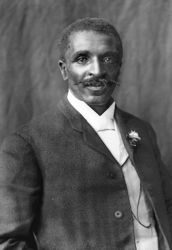
Carver’s was a prominent scientific expert and this made him one of the most famous African-Americans of his time, and he was one of the best-known African-American intellectuals up to that point. By the time of his testimony before congress, however, Carver had already achieved international fame in political and professional circles. President Theodore Roosevelt admired his work and sought his advice on agricultural matters in the United States. Carver was also recognized abroad for his scientific expertise. In 1916, he was made a member of the British Royal Society of Arts—a rare honor for an American. Carver also advised Indian leader Mahatma Gandhi on matters of agriculture and nutrition.
The politics of accommodation championed by both George Washington Carver and Booker T. Washington were not accepted by many activists who wanted more radical change. These two men were not out spoken enough for them. But Carver and Washington, despite involvement with government-funded scientific research and programs, largely remained outside of the political sphere, and declined to criticize prevailing social norms outright. But Carver’s scholarship and research contributed to improved quality of life for many farming families, and made Carver an icon for African-Americans and Anglo-Americans alike.
George Washington Carver used his celebrity to promote scientific causes for the remainder of his life. He wrote a syndicated newspaper column and toured the nation, speaking on the importance of agricultural innovation, the achievements and example of Tuskegee, and the possibilities for racial harmony in the United States. From 1923 to 1933, Carver toured white Southern colleges for the Commission on Interracial Cooperation.
George Washington Carver died on January 5, 1943, at around the age of 78 after falling down the stairs at his home. He was buried next to Booker T. Washington on the Tuskegee grounds. Carver’s epitaph reads: “He could have added fortune to fame, but caring for neither, he found happiness and honor in being helpful to the world.”
LEGACY
George Washington Carver’s reputation and status remained after his death. Carver was a frugal man and used his savings to establish a museum devoted to his work, where others could learn and be inspired. The museum included some of his own paintings and drawings. In December 1947, a fire broke out in the museum, destroying much of the collection. One of the surviving works by Carver is a painting of a yucca and a cactus, displayed at the Chicago World’s Columbian Exposition of 1893. In addition to the museum, Carver also established the George Washington Carver Foundation at Tuskegee, with the aim of supporting future agricultural research.
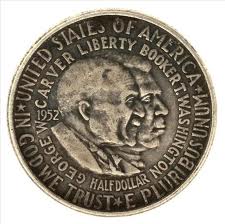
Before his death, a project to erect a national monument in Carver’s honor was begun. Harry S. Truman, then a senator from Missouri, sponsored a bill in favor of a monument during World War II. Supporters of the bill argued that the wartime expenditure was warranted because the monument would promote patriotic fervor among African-Americans and encourage them to enlist in the military. The bill passed unanimously in both houses.
In 1943, President Franklin D. Roosevelt dedicated $30,000 for the Carver monument to be erected west of Diamond, Missouri—the site of the plantation where Carver lived as a child. This was the first national monument dedicated to an African-American. The 210-acre complex includes a statue of Carver as well as a nature trail, museum and cemetery.
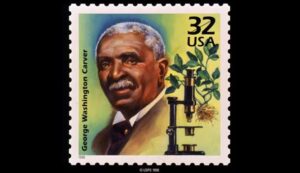
Carver appeared on U.S. commemorative postal stamps in 1948 and 1998. George Washington and Booker T. Washington as well as a commemorative half dollar coin minted between 1951 and 1954. Numerous schools bear his name, as do two United States military vessels. In 2005, the Missouri Botanical Garden in St. Louis opened a George Washington Carver garden, which includes a life-size statue of the garden’s famous namesake. These honors attest to George Washington Carver’s enduring legacy as an icon of African-American achievement, and of American ingenuity more broadly. Carver’s life has come to symbolize the transformative potential of education, even for those born into the most unfortunate and difficult of circumstances.
George Washington Carver. (2012). Biography.com. Retrieved 04:41, Jul 22, 2012 from https://www.biography.com/scientists/george-washington-carver