
The world economy is in trouble, and governments are making things worse. Here’s the story, right out of the pages of the 2012 Index of Economic Freedom, published Thursday by the Heritage Foundation and The Wall Street Journal:
“Rapid expansion of government, more than any market factor, appears to be responsible for flagging economic dynamism. Government spending has not only failed to arrest the economic crisis, but also—in many countries—seems to be prolonging it. The big-government approach has led to bloated public debt, turning an economic slowdown into a fiscal crisis with economic stagnation fueling long-term unemployment.”
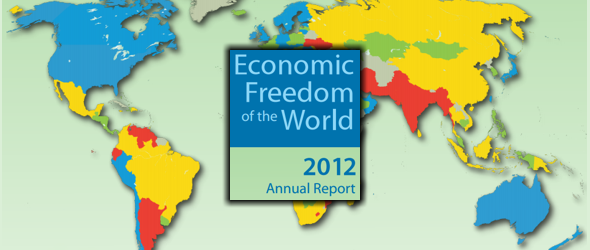
The new index documents a world in which economic freedom is contracting, hammered by excessive government regulations and stimulus spending that seems only to line the pockets of the politically well-connected. Government spending rose on average to 35.2% of gross domestic product (GDP) from 33.5% last year as measured by the 2012 index.
Most of the decline in economic freedom was in countries in North America and Europe. Canada, the United States and Mexico all lost ground in the index, and 31 of the 43 countries in Europe suffered contractions. They ought to know better. These are the very countries that have led the world-wide revolution in political and economic freedom since the end of World War II. But now, weighed down by huge welfare programs and social spending that is out of control, many governments are expanding their reach in ways more reminiscent of the 1930s than the 1980s.
How about the U.S., historically the country more responsible than any other for leading the march of freedom? Under President Barack Obama, it has moved to the back of the band. Its economic freedom score has dropped to 76.3 in 2012 from 81.2 in 2007 (on a scale of 0-100). Government expenditures have grown to a level equivalent to over 40% of GDP, and total public debt exceeds the size of the economy.
The expansion of government has brought with it another critical challenge to economic freedom: corruption. The U.S. score on the index’s Freedom from Corruption indicator has dropped to 71.0 in 2012 from 76.0 in 2007. That’s not surprising, given the administration’s excessive regulatory zeal. Each new edict means a new government bureaucracy that individuals and businesses must navigate. Each new law opens the door for political graft and cronyism.There are some bright spots. Economic freedom has continued to increase in Asia and Africa. In fact, four Asia-Pacific economies—Hong Kong, Singapore, Australia and New Zealand—top the Index of Economic Freedom this year. Taiwan showed impressive gains, moving into the index’s top 20. Eleven of the 46 economies in sub-Saharan Africa gained at least a full point on the index’s economic freedom scale, and Mauritius jumped into the top 10 with the highest ranking—8th place—ever achieved by an
The 2012 index results confirm again the vital linkage between advancing economic freedom and eradicating poverty. Countries that rank “mostly unfree” or “repressed” in the index have levels of poverty intensity, as measured by the United Nations’ new Multidimensional Poverty Index, that are three times higher than those of countries with more economic freedom.
Countries with higher levels of economic freedom have much higher levels of per capita GDP on average. In Asia, for example, the five freest economies have per capita incomes 12 times higher than in the five least free economies. Economic growth rates are higher, too, in countries where economic freedom is advancing. The average growth rate for the most-improved countries in the index over the last decade was 3.7%, more than a point-and-a-half higher than in countries where economic freedom showed little or no gain.
Positive measures of human development in areas such as health and education are highly correlated with high levels of economic freedom, and economically free countries do a much better job of protecting the environment than their more regulated competitors. When you actually look at the performance data, it turns out that the “progressive” outcomes so highly touted by those favoring big government programs to address every societal ill are actually achieved more efficiently and dependably by the marketplace and the invisible hand of free economies.
Unfortunately, most of the world’s people still live in countries where economic freedom is heavily constrained by government control and bureaucracy. India and China, with about one-third of the world’s population, have economic freedom scores barely above 50 (a perfect score would be 100). In a globalized world, both countries are benefiting from the trade and investment liberalization that has taken place elsewhere. But sustained long-term growth will depend on advances in economic freedom within each of these giants so that broad-based market systems may develop.
The Index of Economic Freedom has recorded a step back over the last year for the world as a whole. It was only a small step, with average scores declining less than a point, but the consequences have been severe: slower growth, fiscal and debt crises, and high unemployment. The biggest losers have been the economies in North America and Europe, regions that have led the world in economic freedom over the years.
The 2012 results show the torch of leadership in advancing freedom passing to other regions. Whether this is a long-term trend remains to be seen, but it is clear that if America and Europe do not soon regain trust in the principles of economic freedom on which their historical successes have been built, their people, and perhaps those of the world as a whole, are in for dark days ahead.
Ed Feulner is president of the Heritage Foundation and co-editor of the 2012 Index of Economic Freedom.
Heritage Foundation’s 2012 Index of Economic Freedom PDF
Original Article published on Heritage.org